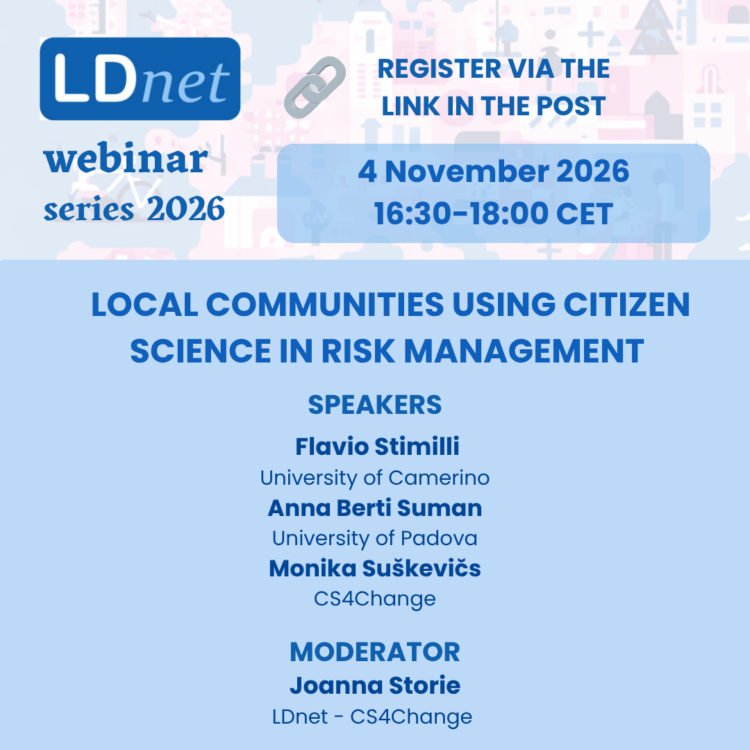
The webinar was moderated by Joanna Storie, LDnet board member (LINK) and researcher with CS4Change and had three main speakers.
Flavio Stimili, researcher at the University of Camerino in Italy (LINK), discussed the role of local communities in disaster risk reduction. He explained that local residents know their area and its history, but their understanding of risks depends on their previous experiences. People may therefore perceive the risks associated with earthquakes, floods, and wildfires differently. Involving a community does not always require reaching hundreds of people at once. It is important to identify local leaders who understand the needs of the area and can involve other residents. Researchers and communities can work together to create risk maps, plan preventive measures, and develop solutions suited to local conditions.
Anna Berti Suman, Assistant Professor at the University of Padua (LINK), presented examples of environmental monitoring carried out by local residents. After the Fukushima nuclear disaster, residents began measuring radiation levels and comparing their results with official government data. In other projects, communities have monitored air quality, industrial pollution, and environmental risks related to oil production. However, community-generated data do not automatically influence official decisions. The data must be sufficiently accurate, and the collection methods must be clearly documented. It also helps to involve public authorities early so that they understand how the information can be used. Researchers and non-governmental organisations can act as intermediaries between communities and decision-makers.
Monika Suškevičs, principal investigator of the CS4Change project (LINK), presented the results of a review covering more than 100 scientific publications. The review showed that citizen science can help people understand environmental risks and strengthen community preparedness. People most often participate by collecting data. They are less frequently involved in defining research questions, assessing results, or developing solutions. Monika stressed that “Citizen science can make risk governance more democratic. When we involve the people directly affected by risks from the beginning, the decisions are more likely to gain their support”.
Summary
The webinar covered different methodological approaches, as well as practical experiences related to earthquakes, floods, wildfires, air pollution, and risks of nuclear and oil pollution. Examples were presented from Italy, the Netherlands, Türkiye, the United States, Ecuador, and Japan.
It was noted that local residents often notice environmental changes before they are detected by official monitoring systems. Citizen science provides a way to collect these observations and experiences systematically and use them to prevent and manage environmental risks.
In conclusion, it was stressed that citizen science is a way to improve risk governance and a take-away point from LDnet’s perspective is that the application of citizen science can contribute to a sound participative approach to local development.
Event announcement and background information
-
Flavio Stimili, urban planning researcher at University of Camerino
- Anna Berti Suman, Tenured Assistant Professor in environmental law & sociology at the University of Padova, Principal Investigator on the “PersoNa Project – Personal Narratives in Climate Litigation” (funded by the Italian Science Fund)
-
Monika Suškevičs, principal investigator for CS4Change, a citizen science research and analysis project funded by the Estonian Research Council (ETAG)
Leave a Reply
You must be logged in to post a comment.