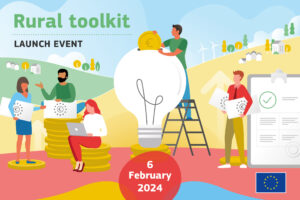
The Rural toolkit is an initiative of the European Commission’s Directorate-General for Regional and Urban Policy (DG REGIO) and Joint Research Centre (JRC), in collaboration with the Directorate-General for Agriculture and Rural Development (DG AGRI). It is the first comprehensive online guide to EU funding and support opportunities for rural areas in the European Union. […]
Theories, tools and practical examples to decode rural community resilience

One-day showcase training offers insights into the REBOUND accredited course on fostering resilience in rural communities. The REBOUND project, supported by the EU through ERASMUS+ programme, developed and piloted an accredited (15 ECTS) training and capacity-building programme on rural community resilience. On the 8th of November 2023 a small group of around 15 experts, practitioners […]
Rural/urban: Laying bare the controversy
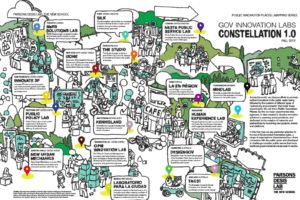
In this paper, published in Geographia Polonica, Mirek Dymitrow of the University of Gothenburg examines the “rural/urban controversy”. Abstract Concepts are the basic building blocks of all knowledge, while the strength of any societal project is dependent on the quality of those concepts. As two of the oldest geographical concepts still in widespread use, ‘rural/urban’ […]
EUI capacity building event on urban CLLD (Timisoara)
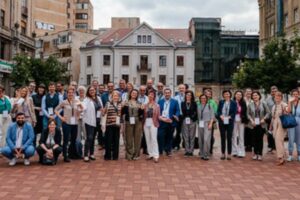
LDnet has been engaged by European Urban Initiative (EUI) for the preparation and delivery of an EUI Capacity building event focused on CLLD. This event took take place in Timisoara (Romania) from 7th to 9th June 2023. It was organised by EUI with help from LDnet, with a team of moderators, expert in CLLD and […]
Social Innovation: The Promise and the Reality in Marginalised Rural Areas in Europe
This paper by Bill Slee, Robert Lukesch and Elisa Ravazzoli explores the idea of social innovation as both a conceptual and practical means of delivering positive social, economic and environmental outcomes in marginal rural areas. Definitions are critically appraised, and the dual contemporary origins of the term social innovation (in management sciences and critical social […]
REBOUND – Training and capacity-building programme
REBOUND is an inter-territorial project supported by the EU through ERASMUS+. It pursues an action-research approach to promoting rural community resilience. LDnet experts participate in the project and its first report on the State of the Art and Practices of Rural Community Resilience has alredy been published. An update on the progress of the REBOUND […]
Social capital and short food supply chains: Evidence from Fisheries LAGs

New empirical research by Richard Freeman, Jeremy Phillipson, Matthew Gorton, Barbara Tocco uses a new methodological approach for understanding the wider impacts of CLLD and how it can be transferred to different contexts. It is presented in an article titled “Social capital and short food supply chains: Evidence from Fisheries Local Action Groups” published in Sociologia Ruralis. […]
Workshop: Multi-funding opportunities expand LEADER’s potential

This workshop of the EU CAP Network on LEADER and multi-funded CLLD approaches was held on 18-19 October 2023 in Ljubljana (SI). It was attended by participants from 20 Member States who exchanged experiences and discussed the challenges and practical solutions in the implementation of multi-funded CLLD at the policy and operational level. The LEADER […]
Euracademy – Györ 27-31 August 2023: Rural communities responding to the climate crisis and commiting themselves to a regenerative future

The Euracademy Association and Széchenyi István University invite participants in the 20th Summer Academy, to be held in Györ, Hungary from 27th to 31st August 2023. Theme: How can rural communities respond to the climate crisis and commit themselves to a regenerative future by changing farming practices? The Euracademy wishes to redefine sustainable rural development […]
State of the Art and Practices of Rural Community Resilience
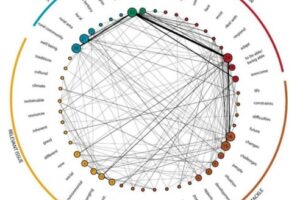
The REBOUND project (Fostering Resilience in Rural Communities) has published a report on the State of the Art and Practices of Rural Community Resilience. The aim of this report is to provide an analysis of innovative processes and patterns pertaining to rural resilience across Europe. It is the first major output of the REBOUND project […]
Local development beyond Europe: UN resolution on the promotion of social and solidarity economy and the localisation of SDGs.

At its 66th plenary meeting on April 18, 2023, the United Nations General Assembly adopted the resolution “Promoting the Social and Solidarity Economy for Sustainable Development” (A/77/L.60). The resolution provides an official definition for the Social and Solidarity Economy and acknowledges that it can contribute to the achievement and localisation of the Sustainable Development Goals. […]
LDnet General Assembly & the debate on “Capacity building for local development”- Key messages & full recording
The General Assembly of LDnet took place online on 14 February 2023. As in previous years, it was open to LDnet members, friends and contributors. The full recording is available HERE. Key points from the presentations and discussions are summarised below. Capacity building for Community Led Local Development Its main theme was devoted to […]