This study was carried out for the REGI Committee of the European Parliament. It was authored by Austėja ŠVEDKAUSKIENĖ, Justas ŠIMANSKAS, Simonas GAUŠAS, Beatričė LEIPUTĖ, Manuela MEJIA, Sally SHORTALL and Sonia DE GREGORIO HURTADO.
In the EU’s rural and remote areas, population decline and a shortage of young women relative to young men interact with obstacles to young women’s economic, social and political participation. This study analyses these challenges and assesses how EU instruments, particularly Cohesion Policy, support young women, with case studies illustrating how this support works in practice. It provides recommendations for the 2028–2034 Multiannual Financial Framework, including post-2027 Cohesion Policy, and the forthcoming ‘Right to Stay’ Strategy.
Key findings
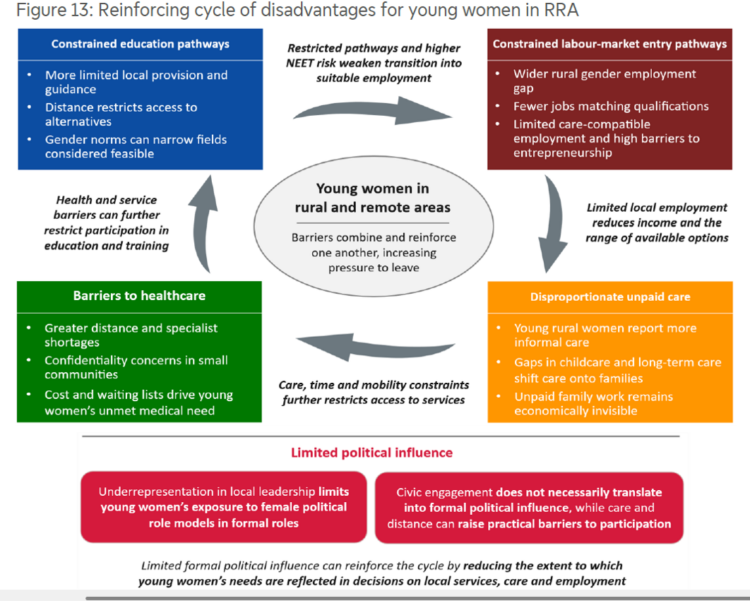
- Barriers in employment, care, services and political participation reinforce one another and increase the pressure for young women to leave RRA
- No EU instrument targets young women in RRA as a group – they are instead reached as women, young people, rural residents or young farmers
- CP funding and complementary LEADER support can address barriers to staying where Managing Authorities and local organisations prioritise them, but their effects on decisions to stay, leave or return remain unmeasured
- The proposed European Fund for 2028–2034 gives greater recognition to rural needs but does not identify the group most likely to leave
Policy recommendations
The study’s recommendations aim to make young women in RRA visible in how the EU targets, allocates, delivers, and monitors support. For the 2028–2034 MFF, the recommendations on the NRPP Regulation and the Performance Regulation include:
- a requirement for each NRPP to analyse disparities between young women and men by type of territory and, where young women in RRA are disadvantaged, to set out combined measures addressing this;
- the exclusion of interventions under the Common Agricultural Policy (CAP) from the proposed target of at least 10% of each Plan for rural areas, so that the target is met through measures such as services, care, transport and employment. Moreover, reporting on the share of the target that reaches remote areas;
- requirements for territorial strategies under Community-Led Local Development (CLLD) and Integrated Territorial Investment (ITI) to analyse the ratio of young women to young men and set measures where young women are underrepresented, and use this ratio to define their coverage, including in transition and more developed regions;
- selection criteria favouring strategies and operations that combine employment or training with services such as childcare or transport, fund outreach and provide multi-annual support;
- the financing of childcare and LTC facilities together with the staff and operating costs needed to run them, with a five-year staffing and operating plan as a condition for selection;
- a breakdown of indicator data on people reached by sex, age group, and degree of urbanisation; recording the location of measures at the Nomenclature of Territorial Units for Statistics (NUTS) 3 level; and evaluating results for young women in RRA where Plans identify them as disadvantaged.
For the upcoming ‘Right to Stay’ Strategy, the recommendations include:
- the inclusion of young women in RRA among the Strategy’s priority groups and objectives for people as well as places, such as reducing the gap between the numbers of young women and young men in RRA, supported by EU-level reporting on how many young women stay in, leave and return to RRA, also used to assess the European Fund’s right-to-stay objective;
- priority for childcare and LTC capacity in RRA in the Strategy’s guidance on EU funds, with progress towards the 2030 Barcelona targets reported by degree of urbanisation, and reference travel times by public transport from RRA to care and healthcare services;
- measures supporting local education and employment, support for women’s entrepreneurship with administrative requirements proportionate to business size, routes from community engagement into local decision-making, and Youth Guarantee outreach directed towards young women in RRA.
The study report is available HERE

Leave a Reply
You must be logged in to post a comment.