• Home
  • About
    • What is LDnet?
    • LDnet Board
    • Join LDnet
    • LD Who’s Who
    • LD Organisations
      • Pactes Locaux
      • World Bank
      • ITC-ILO
      • FARNET
      • ENRD
      • OECD
      • URBACT
      • ELARD
    • Guidance for registered authors to the LDnet website
    • Register to the site to become a contributor
    • Personal data policy
  • Events
    • LDnet events & activities
    • Other LD events & activities
  • Publications
    • LDnet Articles
    • LD Books & Studies
    • LD Evaluations
    • The Local Development Ebook
  • Programmes
    • EU LD Policies & Programmes
    • CLLD
    • FARNET
    • LEADER
    • URBACT
    • Other LD Policies & Programmes
      • International LD programmes
      • LD Policies & Programmes by Country
  • Webinars
  • Resources
    • CLLD in Europe
    • CLLD country profiles
    • LDnet Webinars
    • LDnet Ebook
    • LD Handbooks
    • LD Good Practices
      • LD Practices by Country
    • LD References [Bibliography]
    • LD Glossary
  • Contact Page

LDnet

Local Development Network

  • CLLD
  • Rural
  • Urban
  • Jobs
  • Social Inclusion

Rural Movements and Parliaments in Europe

Rural Movements and Parliaments in Europe as Agents of Socio-Political Landscapes: Social Innovation, Identity Re-Creation, Democratic Renewal and Professionalisation in Times of Rural Transformation
This paper has been co-authored by three members of LDnet, Alistair Adam Hernández, Neslihan Önder Özen and Joanna Tamar Storie, together with Tobias Federwisch and Karl Martin Born.

European rural communities face profound transformations driven by demographic change, economic restructuring, service erosion, and political marginalisation. In response, Rural Movements (RMs) and Rural Parliaments (RPs) have emerged as important actors shaping the socio-political dimensions of rural landscapes.

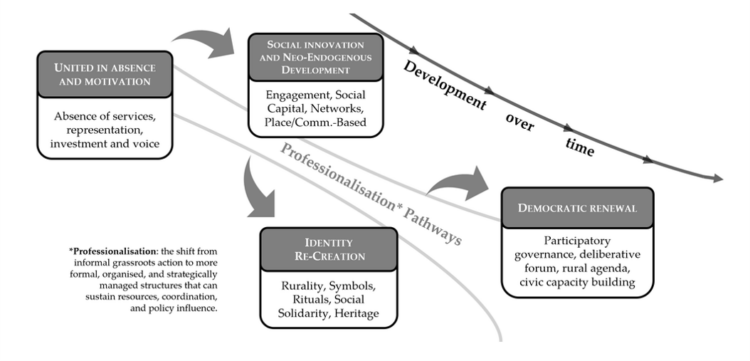
Drawing on the European Landscape Convention’s understanding of landscape as shaped by both natural and human factors, this article conceptualises RMs and RPs as co-producers of rural socio-political landscapes through advocacy, identity-building, community mobilisation, and institutional engagement.

The study combines a qualitative literature review with exploratory empirical material from two expert workshops conducted at the 6th European Rural Parliament (Inverurie, Scotland, October 2025), involving representatives from eight European countries. The analysis examines RMs and RPs as agents of social innovation, arenas of identity preservation and reinvention, infrastructures of democratic renewal, and navigators of the professionalisation-institutionalisation dilemma.

Findings suggest that many movements emerged in response to centralisation, service loss, weakened local influence, and democratic deficits. Professionalisation is understood as the development of organisational capacities, advocacy skills, and strategic networks while maintaining grassroots legitimacy and local embeddedness.

The article identifies key factors that enable and constrain movement development and concludes that the transformative potential of RMs and RPs depends on balancing organisational effectiveness with participatory, locally rooted, and politically autonomous forms of action.

The full article is available HERE

Filed Under: LD Books & Studies, Publications, Uncategorized Tagged With: Rural, Rural Communities LDnet

About LDnet

The European forum for sharing information and knowledge among experts, researchers and practitioners in local development.

Leave a Reply Cancel reply

You must be logged in to post a comment.

This site uses Akismet to reduce spam. Learn how your comment data is processed.

  • Bluesky
  • E-mail
  • LinkedIn
  • Twitter

Get Involved with LDnet

  • Support LDnet
  • Join LDnet
  • Partner & Expert Search
  • Register to the site to become a contributor

Email Newsletter

Sign up to receive email updates and to hear what's going on with LDnet!

Personal data policy

Popular Tags

Capacity building Climate Change Adaptation CLLD Coastal Cohesion policy Community development Community involvement Endogenous growth Entreprenurship ESIF EU funds EU policies Evaluation Finance Financial engineering Fisheries Governance Green transition innovation Integrated approach Jobs Leader LEI Local development Local development approach Local development strategy Local economy local governance Participation Partnerships Regeneration Research Resilience Rural Rural Communities SMEs Social economy Social inclusion social innovation Sub-Saharan Africa Sustainable Development Territorial approaches Third sector Third system Urban

About LDnet

LDnet is an informal network set up in 2011 to bring together knowledge and people in local development. People who wish to make a contribution to local development can participate in the network. LDnet is supported by the non-profit European Local Development Network Association (taking over this role from the LEDA-Partenariat Association). … read more

Become a Contributor

  • Join LDnet
  • Register to the site to become a contributor

Contributors

avatar for
avatar for
avatar for
avatar for
avatar for
avatar for
avatar for
avatar for
avatar for
avatar for
avatar for
avatar for
avatar for
avatar for
avatar for
avatar for
avatar for
avatar for
avatar for
avatar for
avatar for
avatar for
avatar for
avatar for
avatar for

© 2011–2026 LDnet · Log in · Join LDnet · Register to the site to become a contributor · Personal data policy