This study on Circular Economy and Cohesion Policy Funds was published in October 2026 in the series Research for REGI Committee of the European Parliament.
The study examines how Cohesion Policy supports the circular economy, mapping allocations, implementation progress and territorial investment patterns. Drawing on EU policy analysis, programme data and five regional case studies, the study identifies delivery gaps and sets out recommendations for the forthcoming Circular Economy Act and the 2028–2034 Multiannual Financial Framework.
Policy recommendations for the 2028-2034 framework
The proposed post-2027 architecture creates both an opportunity and a risk. National and Regional Partnership Plans could connect investments currently divided between environmental infrastructure, competitiveness, innovation, skills and territorial development. This could reduce fragmentation.
At the same time, greater integration could make circular economy less visible if investments are absorbed into broad green or competitiveness envelopes. Greater national flexibility could also weaken territorial ownership if regional and local authorities do not retain an effective role in programming and implementation.
The decisive question for the European Parliament is therefore not simply whether circular economy remains eligible for support after 2027, but whether it remains traceable and becomes more systemic, territorially grounded and measurable.
The report identifies eight policy recommendations for the 2028–2034 framework:
- Preserve the visibility of circular economy within National and Regional Partnership Plans through a common classification of circular functions.
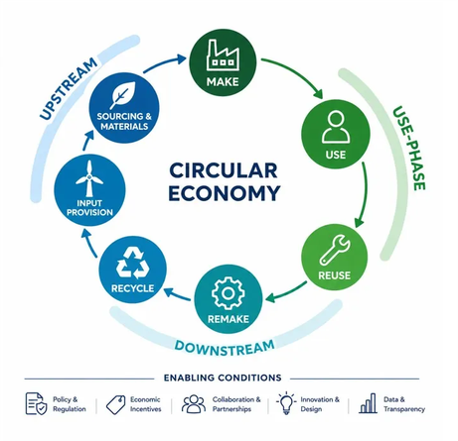
- Rebalance support across the full life cycle, while recognising different territorial starting points and continuing essential waste-system investment where needed.
- Create demand for circular products and secondary raw materials through procurement, standards, certification, traceability and stronger links between suppliers and industrial users.
- Give regional and local actors operational roles, with clear responsibilities for preparation, implementation and monitoring.
- Coordinate EU, national and regional instruments around territorial circular-economy pathways, identifying gaps, overlaps and complementarities.
- Match financing and delivery arrangements to different interventions, including technical assistance, grants, financial instruments and staged milestones.
- Connect circular investment to skills, employment, the social economy and territorial inclusion, particularly in repair, reuse and refurbishment ecosystems.
- Measure circular transformation, not only expenditure and infrastructure, distinguishing procedural progress, outputs and genuine outcomes such as waste prevention, product-life extension and actual secondary-material uptake.
Cohesion Policy can translate common EU rules and market objectives into functioning regional circular systems. The next period should connect essential waste infrastructure with higher-value circular activity, bring innovation to markets and territories, and strengthen competitiveness, resilience and cohesion.

Leave a Reply
You must be logged in to post a comment.